Can you be offside If you are level with the last defender?
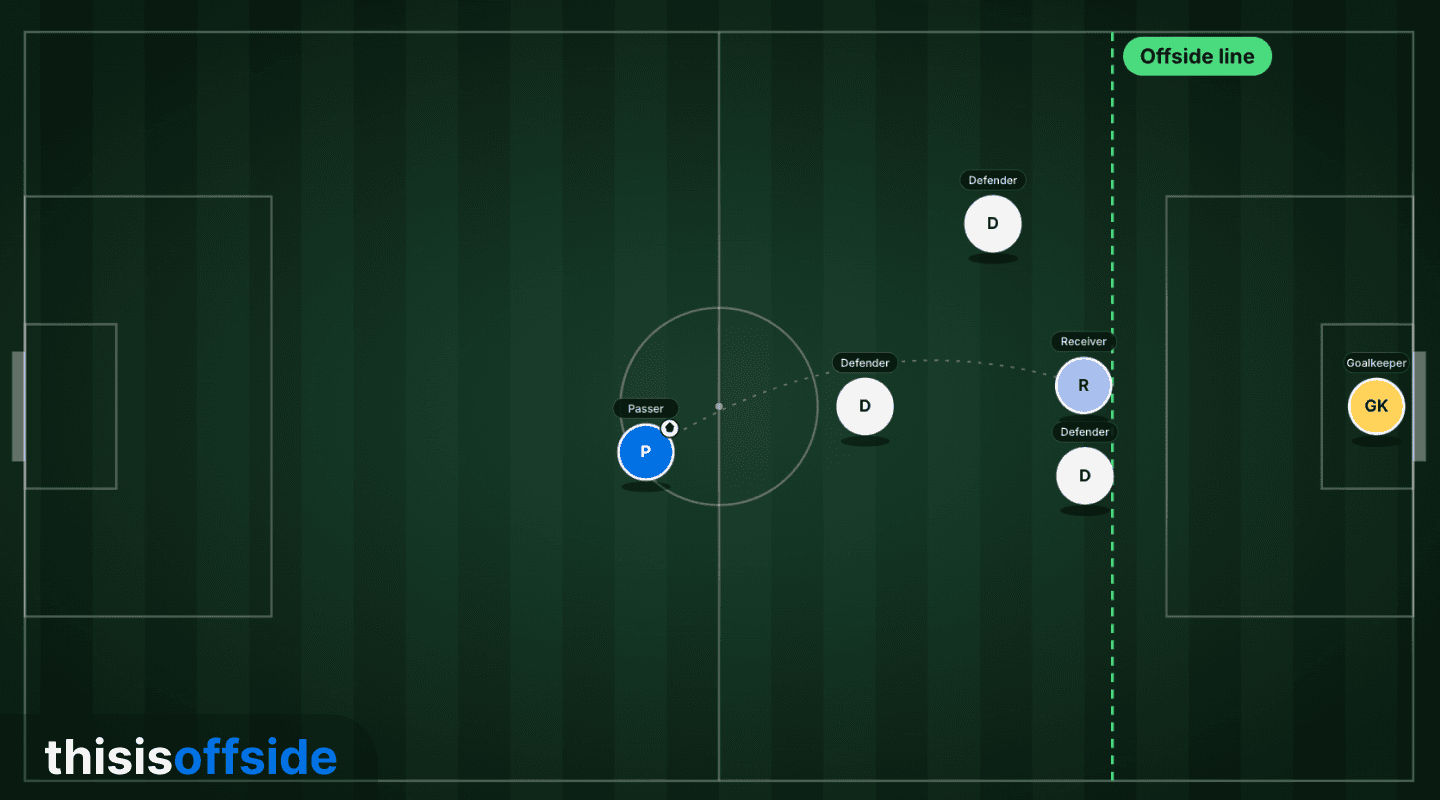
No. If you are level with the last defender, you are on-side.
This is one of the most important details in the offside rule. The rule only penalises you if you are clearly ahead of the defender. Level is never enough.
When it is a tie, the attacker wins.
What "level" actually means in the offside rule
The offside rule measures your position by the body part that can legally play the ball.
That means your head, torso, or feet. Arms and hands do not count.
If any of those body parts is level with the second-to-last defender at the moment the ball is played, you are on-side. You need to be clearly past the defender to be penalised.
This is why VAR lines are drawn so precisely. A millimetre makes a difference.
Why the tie goes to the attacker
The Laws of the Game are deliberately worded this way.
A player is only in an offside position if they are "nearer to the opponent's goal line than both the ball and the second-to-last opponent."
Level is not nearer. So level is on-side.
The burden of proof falls on the offside call, not on the goal. If there is any doubt, play continues.
How VAR measures this
Before VAR, referees and their assistants had to judge level positions in real time from the touchline. It was genuinely difficult and often wrong.
VAR changed this by using freeze-frame technology to pause the video at the exact moment the ball is played. Officials then draw lines along the relevant body parts to compare positions.
Since 2022, most major competitions also use semi-automated offside technology. This system uses multiple cameras and player tracking data to calculate positions automatically, reducing the margin for human error further.
Even with all of this, close calls still get decisions wrong sometimes. But the principle remains: level means on-side.
A concrete example for last defender offside
Imagine a through ball is played.
At the exact moment of the pass, the striker's shoulder is exactly level with the last outfield defender's shoulder.
On-side. Play continues.
Now shift the striker forward by one centimetre, just enough so the shoulder is past the defender.
Offside. Flag goes up.
The difference between a legal goal and a disallowed one can be smaller than the width of a finger.
The body part that matters in the last defender offside rule
This is where it gets slightly technical.
The part of the attacker's body that is compared to the defender is the part that is furthest forward, whichever part is closest to the goal line.
So if a striker's arm is past the defender but their torso is level, they are on-side. Arms do not count.
But if their outstretched foot is past the defender while the rest of their body is level, that foot is what gets measured. That would be offside.
This is exactly why VAR sometimes draws lines across very specific body parts, a hip, a shoulder, a heel, because that is the furthest legal point.
Why this rule matters for defenders
Defenders use this rule actively.
A well-timed defensive line is designed to put attackers in offside positions the moment the ball is played. Getting the timing right by a fraction of a second is the difference between a clean trap and giving up a one-on-one with the goalkeeper.
Understanding that level is on-side also matters for defenders. Stopping half a step short of the attacker is not enough. They need to be clearly behind, or the attacker gets the benefit of the doubt.
Test the last defender offside yourself
Want to see exactly where the offside line falls and how level positions work? Try our interactive offside simulator and drag the players to see the rule react in real time.