Offside from a free kick?
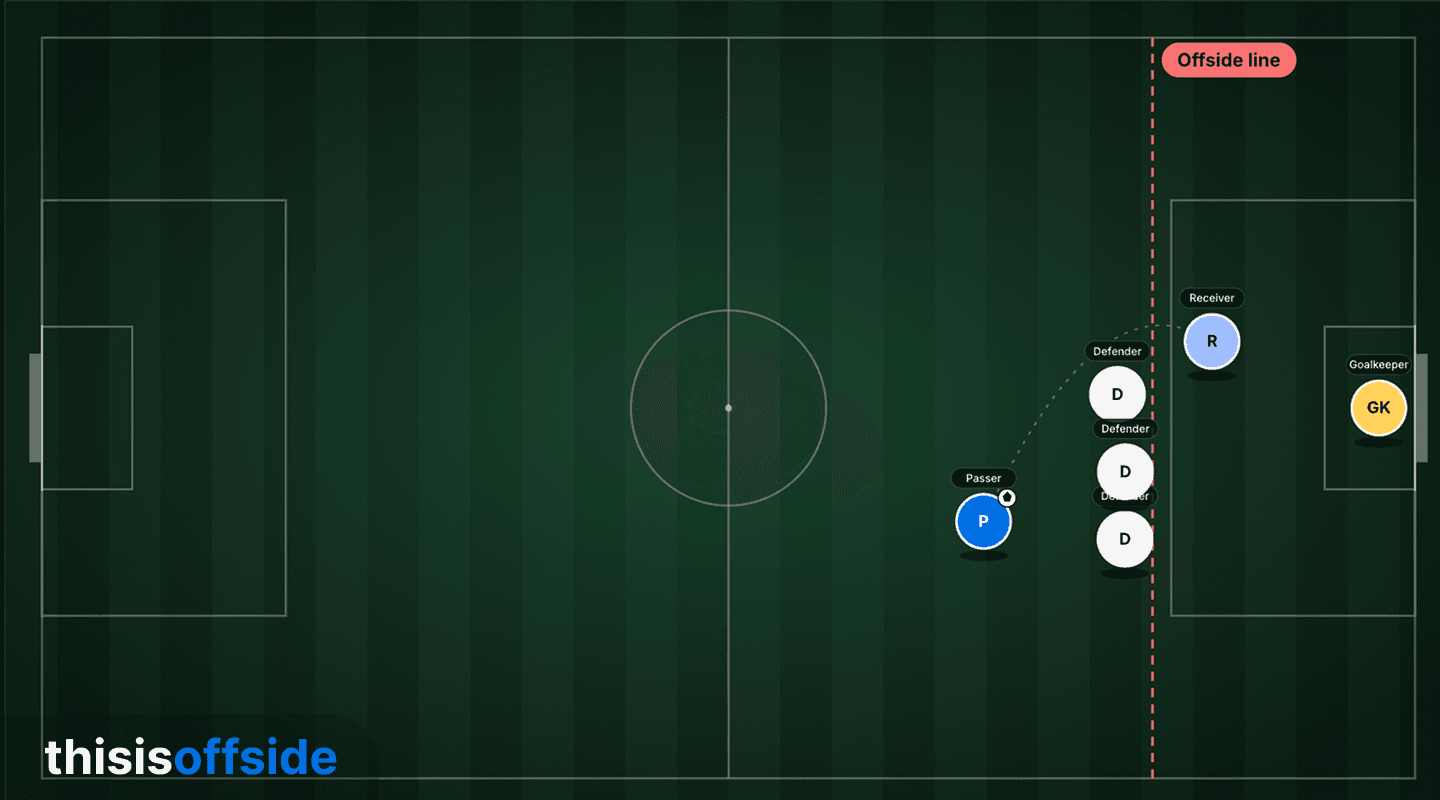
It depends on the type of free kick.
For direct and indirect free kicks, the offside rule applies normally once the ball is in play.
But there is one important exception: you cannot be offside if you are standing in your own half when the free kick is taken.
This is one of the more nuanced situations in the offside rule and one that confuses a lot of fans.
How the offside free kick rule works in open play
When a free kick is taken, it is treated like any other moment in open play the moment the ball moves.
If you are ahead of the last defender and in the opponent's half when your teammate plays the free kick, you are in an offside position and can be penalised.
This is different from throw-ins and corner kicks, where offside is suspended entirely. Free kicks do not get that exemption.
The one exception: standing in your own half
You cannot be offside if you are in your own half when the free kick is taken.
The same rule that applies to normal open play applies here. Your position at the exact moment the ball is played is what matters, not where you run to afterwards.
So this is completely legal:
Your team wins a free kick deep in their own half
You are standing just behind the halfway line
Your teammate plays a long ball forward
You sprint into the attacking half and receive it
No flag. You were in your own half at the moment of the kick.
A scenario that trips fans up
Imagine your team wins a free kick just inside the opponent's half.
A striker is standing five metres ahead of the last defender, waiting for the ball.
Your teammate plays the free kick forward to that striker.
Offside. The free kick does not suspend the rule. The striker was in an offside position at the moment the ball was played, in the opponent's half, and ahead of the last defender.
This is the key difference between a free kick and a corner kick or throw-in. Those restarts suspend offside completely. A free kick does not.
What about the defensive wall?
When a defensive wall is set up, attacking players sometimes try to stand in the wall or near it.
They are allowed to do this without being offside, as long as they are not in an offside position when the kick is taken.
Defenders often try to push their line up at free kicks to catch attackers offside. This is completely legal and is actually a common defensive tactic at set pieces.
Offside free kick situations that catch everyone out
A few scenarios where fans regularly get confused:
Quickly taken free kicks. If a free kick is taken quickly before defenders reorganise, attackers who were onside a moment earlier can suddenly find themselves in an offside position. The position at the exact moment the kick is taken is all that matters.
A free kick played backwards. If the ball is played backwards, offside cannot be given since no attacker can be ahead of the ball in that direction.
Rebound from the wall. If the ball hits the defensive wall and rebounds to an attacker in an offside position, that attacker can be penalised. The free kick exemption does not cover rebounds.
How this compares to other set pieces
Here is how the offside rule applies across different restarts:
Free kick. Offside applies normally once the ball is played.
Corner kick. Offside is suspended entirely.
Throw-in. Offside is suspended entirely.
Goal kick. Offside is suspended entirely.
Kick-off. Offside is suspended entirely.
Free kicks are the only set piece restart where the normal offside rule still applies. That is worth remembering.
Test free kick offside yourself
Want to see exactly where the offside line falls in different situations? Try our interactive offside simulator and drag players into position to see the rule in action.