Offside in your own half?
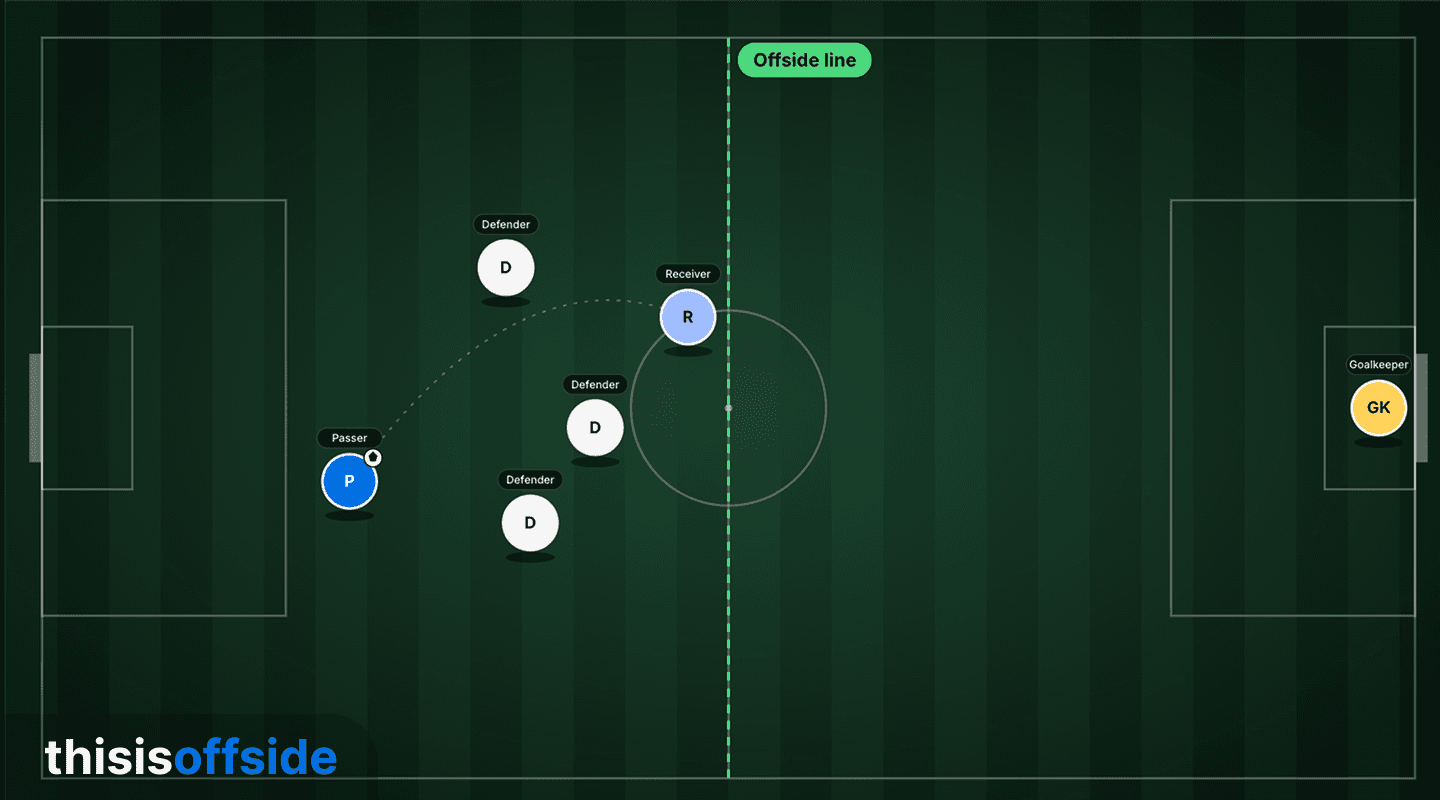
No. You cannot be offside in your own half of the pitch.
It does not matter how many defenders are ahead of you or where the ball is played from.
If you are standing on your own side of the halfway line when you receive the ball, the offside rule does not apply.
This is one of the clearest and most absolute exceptions in football.
Why offside in your own half is a safe zone
The offside rule only applies in the opponent's half of the pitch.
The halfway line itself also counts as safe. A player standing exactly on the line is considered to be in their own half and cannot be offside.
The logic is straightforward. The rule exists to stop attackers camping near the opponent's goal waiting for the ball.
In your own half, you are far enough from goal that this advantage does not exist.
What happens at the moment of the pass
The key moment is when the ball is played, not when you receive it.
This is where it gets slightly more nuanced. If you are in your own half when your teammate plays the ball, you are safe.
Even if you sprint forward into the opponent's half and then receive it, you are still onside.
What matters is where you were standing at the exact moment the ball left your teammate's foot.
So this is completely legal:
You are standing just inside your own half
Your teammate plays the ball forward
You sprint past two defenders into the attacking half
You receive the ball and score
No flag. You were onside at the moment of the pass. Everything after that is irrelevant to the offside decision.
A common scenario fans get wrong in offside own half
Imagine a goalkeeper rolling the ball out to a centre-back deep in their own half.
A striker is standing two metres ahead of the last defender, clearly in what would be an offside position if they were in the attacking half.
The centre-back plays a long ball forward to that striker.
No offside. The centre-back was in their own half when they played the ball. The offside rule does not apply.
This catches a lot of fans out, especially when the ball travels a long distance and the attacker looks suspiciously far forward.
The halfway line: which side counts?
Standing exactly on the halfway line means you are not in the opponent's half, so you cannot be offside.
You only enter the zone where offside applies the moment any part of your body that can legally play the ball crosses into the opponent's half.
That means head, feet, or torso. Arms and hands do not count, just as they do not count in the offside decision itself.
How this connects to passive offside
Even if you drift slightly into the opponent's half, you are not automatically penalised.
You also have to be actively involved in the play. If you are in a technical offside position but not touching the ball, blocking a defender, or influencing play, the referee lets the game continue.
This is called passive offside, and it is worth understanding alongside this rule.
Test offside from your own half yourself
Want to see exactly where the offside line falls and when a player gets penalised? Try our interactive offside simulator and drag players into different positions to see the rule in action.